

Learn about City of St. Louis Investor Relations including our STL Sustainability, News & Press Releases, Projects, and Team.
Talk to us
Have questions? Reach out to us directly.
Learn about City of St. Louis Investor Relations including our STL Sustainability, News & Press Releases, Projects, and Team.
About City of St. Louis Investor Relations
The City of St. Louis is located on the Mississippi River, the eastern boundary of the State of Missouri, just below its confluence with the Missouri River. The City occupies 61.74 square miles of land and its area has remained constant since 1876. The City, a constitutional charter city not part of any county, is organized and exists under and pursuant to its Charter and the Constitution and laws of the State of Missouri.
The City is popularly known as the “Gateway of the West,” due to its central location and historic role in the nation’s westward expansion. Commemorating this role is the 630 foot stainless steel Gateway Arch, the world’s tallest man made monument, which is the focal point of the 86 acre Jefferson National Expansion Memorial on the downtown riverfront.
While the City was originally incorporated as a town in 1809 and a city in 1823, the current City charter was adopted in 1923 by the electorate.
For more city and regional demographic and economic information visit the St. Louis Regional Chamber and Growth Association [greaterstlinc.com] website.
STL Sustainability
The City of St. Louis harnesses the strength and spirit of its diverse community to create an economically, socially and ecologically vibrant City for present and future generations – one that dynamically serves those who live, work and play in the City’s rich and celebrated historic landscape.
News
“The reaffirmation by Moody’s is a clear vote of confidence in the airport’s current fiscal standing and the continued dedication of our office.”
09 Sep 2026
Moody’s Ratings has affirmed the City of St. Louis’ credit rating of “A2” on its Airport Enterprise’s Airport Revenue Bonds. The outlook for Series 2026A, Series 2026B, and Series 2026C remains stable.
The A2 rating reflects Moody’s expectation of stable credit metrics, supported by the airport’s solid position within the Missouri-Illinois service area and a strong Airline Use and Lease Agreement (AULA).
“The reaffirmation by Moody’s is a clear vote of confidence in the airport’s current fiscal standing and the continued dedication of our office,” Comptroller Donna M.C. Baringer said. “As St. Louis Lambert International Airport embarks on the Consolidated Terminal Project (CTP), our office remains committed to maintaining financial stability, transparency, and effective long-term planning.”
Moody’s noted that sustaining strong debt service coverage ratios, keeping enplanements competitive, and seeing demographic growth in the St. Louis region could lead to an upgraded rating in the future. However the city needs to sustain a sound financial performance over the next two years. ###
Comptroller Donna M.C. Baringer is the chief fiscal officer of the City of St. Louis and is charged with safeguarding the city’s credit rating and protecting taxpayer dollars. Learn more about the Office of the Comptroller.
The report recognizes the city’s strong financial position, improved reserves and liquidity, and continued commitment to structural balance.
(St. Louis - August 14, 2026) - Moody’s has revised the City of St. Louis’ credit outlook to positive, while affirming the city’s “A2” credit rating.
The report recognizes the city’s strong financial position, improved reserves and liquidity, and continued commitment to structural balance. Moody’s also noted the city’s diverse economy and role as the regional employment center, while identifying ongoing challenges including the below-average incomes, population decline, and long-term infrastructure needs.
“This positive outlook from Moody’s is a clear recognition of the City of St. Louis’ continued commitment to sound financial management,” Comptroller Donna M.C. Baringer said. “Our strong reserves and focus on structural balance give us a solid foundation to make strategic investments in the future of our city while maintaining fiscal responsibility.”
The city’s available fund balance stood at approximately $941 million, with approximately $1.16 billion in net unrestricted cash at the end of the fiscal year 2025. Available fund balance represented approximately 61.5 percent of revenue, while liquidity was approximately 76 percent of revenue.
Moody’s concluded that the city’s positive outlook reflects its expectation that St. Louis will maintain a healthy financial position despite the planned used of Rams settlement funds for one time capital projects. The agency expects the city’s available fund balance to remain about 45 percent of revenue at the close of fiscal year 2027.
A $30 million grant from the Federal Aviation Administration will be used by St. Louis Lambert International Airport to help pay for the construction of a modernized electricity facility that’s central to the airport’s plan to consolidate its two terminals into one.
The grant, which was lauded by public officials on Thursday, will be combined with another $20 million awarded last year for the project.
“It’s what will keep this airport running on a daily basis, keep everything alive, keep all the generators running and also be able to ensure that we’ve got the resilience that we currently have concerns about,” Lambert Director Rhonda Hamm-Niebruegge said.
The renovation of what is known as the central utility plant, which was originally built in 1956, and a new Ameren substation will cost roughly $200 million. The remainder of the project not covered by the federal grants will be paid with bonds issued by Lambert.
Republican Sen. Eric Schmitt and Democratic Rep. Wesley Bell, who both advocated for the FAA grant, described the modernized terminal as needed for the region.
“Not only does it have to do with the future prosperity of this region, it also has to do with the self-esteem of the region,” Schmitt said. “This is a great place in our country, a great American city, a region that has a lot to be proud of and deserves an airport that gets us from here to there that is a showcase for this great part of the country.”
With an improved airport, the federal lawmakers and other regional officials also believe the St. Louis region will be more competitive for businesses to move into the region or expand current operations.
“When companies decide where to expand and create job hubs, the status of the airport is one of the first things that they look at,” Bell said. “Too often, Lambert’s aging infrastructure has been a factor in St. Louis becoming excluded from those conversations. This federal investment helps make St. Louis more competitive by improving and expanding the airport.”
The consolidation St. Louis Lambert International Airport would be centered around Terminal 1, pictured on Thursday.
It’s expected the consolidated terminal, which would branch out of the existing first terminal, would first open in phases by 2028 and would be complete by 2032. The single terminal would consist of 62 gates, expanded concessions, improved roadways and a new parking garage.
The airlines that operate out of Lambert and will largely finance the consolidation have approved the preparation work for the project and roughly 30% of the design. They are expected to give their final decision on the whole project next fall when the design stage will reach 60% completion and a firm price tag will be set.
When introduced in 2022, Lambert officials anticipated the consolidation to cost between $2.8 billion and $3 billion, but that’s expected to increase due to inflation and higher costs for labor and materials.
Eventually, the area officials are hopeful Lambert can one day return to its hub status that it held until the 2000s after American Airlines bought Trans World Airlines.
Hamm-Niebruegge, who’s retiring this fall after leading the airport for 16 years, believes it would take population growth in the area to persuade an airline to make Lambert a hub like those in Chicago, Dallas, New York, Philadelphia or Atlanta.
“They’re seeing continued growth in some of those regions, which is important to the airlines to know not only the local numbers there, but, as we bring connecting traffic through, those costs can be viable,” Hamm-Niebruegge said.
Mayor Cara Spencer said the FAA’s decision to award Lambert the grant is “a vote of confidence” in the airport’s future.
“You can count on the City of St. Louis to be a continued partner in this work — regardless of political lines, regardless of other factionalization that has occurred from time to time in the political landscape,” Spencer said. “We are here to do this work together.”
Projects
Team

Donna M.C. Baringer

Ryan Coleman

Jason Fletcher
American Rescue Plan Act Funding
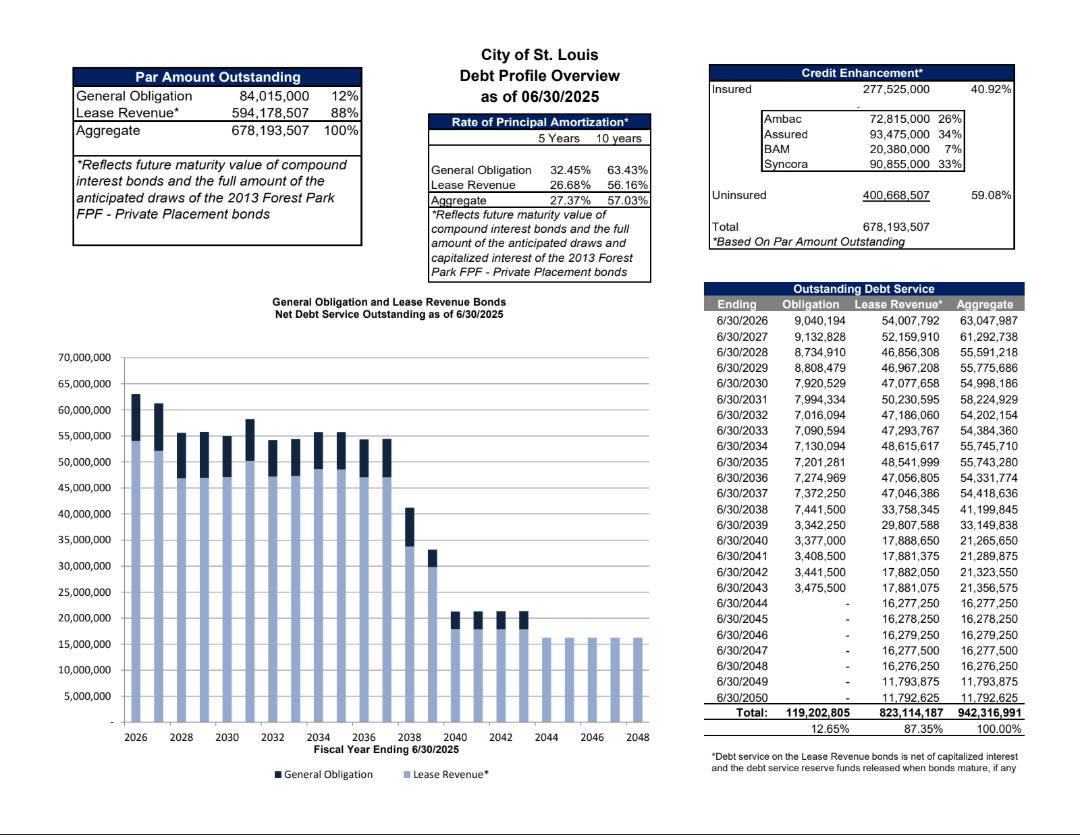
Debt Overview
Talk to us
Have questions? Reach out to us directly.