

Learn about the latest News & Events for City of St. Louis Investor Relations, and sign up to receive news updates.
Get Issuer Alerts
Add this issuer to your watchlist to get alerts about important updates.
Learn about the latest News & Events for City of St. Louis Investor Relations, and sign up to receive news updates.
Upcoming Events
No upcoming events. Add this issuer to your watchlist to get alerts about important updates.News & Press Releases
“The reaffirmation by Moody’s is a clear vote of confidence in the airport’s current fiscal standing and the continued dedication of our office.”
09 Sep 2026
Moody’s Ratings has affirmed the City of St. Louis’ credit rating of “A2” on its Airport Enterprise’s Airport Revenue Bonds. The outlook for Series 2026A, Series 2026B, and Series 2026C remains stable.
The A2 rating reflects Moody’s expectation of stable credit metrics, supported by the airport’s solid position within the Missouri-Illinois service area and a strong Airline Use and Lease Agreement (AULA).
“The reaffirmation by Moody’s is a clear vote of confidence in the airport’s current fiscal standing and the continued dedication of our office,” Comptroller Donna M.C. Baringer said. “As St. Louis Lambert International Airport embarks on the Consolidated Terminal Project (CTP), our office remains committed to maintaining financial stability, transparency, and effective long-term planning.”
Moody’s noted that sustaining strong debt service coverage ratios, keeping enplanements competitive, and seeing demographic growth in the St. Louis region could lead to an upgraded rating in the future. However the city needs to sustain a sound financial performance over the next two years. ###
Comptroller Donna M.C. Baringer is the chief fiscal officer of the City of St. Louis and is charged with safeguarding the city’s credit rating and protecting taxpayer dollars. Learn more about the Office of the Comptroller.
The report recognizes the city’s strong financial position, improved reserves and liquidity, and continued commitment to structural balance.
(St. Louis - August 14, 2026) - Moody’s has revised the City of St. Louis’ credit outlook to positive, while affirming the city’s “A2” credit rating.
The report recognizes the city’s strong financial position, improved reserves and liquidity, and continued commitment to structural balance. Moody’s also noted the city’s diverse economy and role as the regional employment center, while identifying ongoing challenges including the below-average incomes, population decline, and long-term infrastructure needs.
“This positive outlook from Moody’s is a clear recognition of the City of St. Louis’ continued commitment to sound financial management,” Comptroller Donna M.C. Baringer said. “Our strong reserves and focus on structural balance give us a solid foundation to make strategic investments in the future of our city while maintaining fiscal responsibility.”
The city’s available fund balance stood at approximately $941 million, with approximately $1.16 billion in net unrestricted cash at the end of the fiscal year 2025. Available fund balance represented approximately 61.5 percent of revenue, while liquidity was approximately 76 percent of revenue.
Moody’s concluded that the city’s positive outlook reflects its expectation that St. Louis will maintain a healthy financial position despite the planned used of Rams settlement funds for one time capital projects. The agency expects the city’s available fund balance to remain about 45 percent of revenue at the close of fiscal year 2027.
A $30 million grant from the Federal Aviation Administration will be used by St. Louis Lambert International Airport to help pay for the construction of a modernized electricity facility that’s central to the airport’s plan to consolidate its two terminals into one.
The grant, which was lauded by public officials on Thursday, will be combined with another $20 million awarded last year for the project.
“It’s what will keep this airport running on a daily basis, keep everything alive, keep all the generators running and also be able to ensure that we’ve got the resilience that we currently have concerns about,” Lambert Director Rhonda Hamm-Niebruegge said.
The renovation of what is known as the central utility plant, which was originally built in 1956, and a new Ameren substation will cost roughly $200 million. The remainder of the project not covered by the federal grants will be paid with bonds issued by Lambert.
Republican Sen. Eric Schmitt and Democratic Rep. Wesley Bell, who both advocated for the FAA grant, described the modernized terminal as needed for the region.
“Not only does it have to do with the future prosperity of this region, it also has to do with the self-esteem of the region,” Schmitt said. “This is a great place in our country, a great American city, a region that has a lot to be proud of and deserves an airport that gets us from here to there that is a showcase for this great part of the country.”
With an improved airport, the federal lawmakers and other regional officials also believe the St. Louis region will be more competitive for businesses to move into the region or expand current operations.
“When companies decide where to expand and create job hubs, the status of the airport is one of the first things that they look at,” Bell said. “Too often, Lambert’s aging infrastructure has been a factor in St. Louis becoming excluded from those conversations. This federal investment helps make St. Louis more competitive by improving and expanding the airport.”
The consolidation St. Louis Lambert International Airport would be centered around Terminal 1, pictured on Thursday.
It’s expected the consolidated terminal, which would branch out of the existing first terminal, would first open in phases by 2028 and would be complete by 2032. The single terminal would consist of 62 gates, expanded concessions, improved roadways and a new parking garage.
The airlines that operate out of Lambert and will largely finance the consolidation have approved the preparation work for the project and roughly 30% of the design. They are expected to give their final decision on the whole project next fall when the design stage will reach 60% completion and a firm price tag will be set.
When introduced in 2022, Lambert officials anticipated the consolidation to cost between $2.8 billion and $3 billion, but that’s expected to increase due to inflation and higher costs for labor and materials.
Eventually, the area officials are hopeful Lambert can one day return to its hub status that it held until the 2000s after American Airlines bought Trans World Airlines.
Hamm-Niebruegge, who’s retiring this fall after leading the airport for 16 years, believes it would take population growth in the area to persuade an airline to make Lambert a hub like those in Chicago, Dallas, New York, Philadelphia or Atlanta.
“They’re seeing continued growth in some of those regions, which is important to the airlines to know not only the local numbers there, but, as we bring connecting traffic through, those costs can be viable,” Hamm-Niebruegge said.
Mayor Cara Spencer said the FAA’s decision to award Lambert the grant is “a vote of confidence” in the airport’s future.
“You can count on the City of St. Louis to be a continued partner in this work — regardless of political lines, regardless of other factionalization that has occurred from time to time in the political landscape,” Spencer said. “We are here to do this work together.”
Boeing named its St. Louis site the headquarters of the Boeing Defense, Space & Security (BDS) business. The move emphasizes company leadership’s commitment to being present and engaged with teammates who are designing, producing and delivering vital defense and space products and capabilities for customers in the U.S. and around the world.
Boeing in the St. Louis region
- Employees: 18,000+
- Highlights:
- Defense aircraft and munitions production and modernization
- Advanced fabrication capabilities
- Services and sustainment support
- Engineering, Supply Chain, Quality and other capability centers
- Phantom Works advanced prototyping and Virtual Warfare Centers
Employees in the St. Louis area also support Boeing Global Services, Boeing Commercial Airplanes and enterprise functions.
“It’s important for leaders to be side-by-side with our teammates, listening to their feedback and acting to remove obstacles as we continue to stabilize and strengthen our business,” said Steve Parker, Boeing Defense, Space & Security CEO. “The headquarters move, coupled with our senior leaders being based at and spending their time at major engineering, production and manufacturing centers across the U.S., reflects our continued focus on disciplined performance across our business.”
The change moves the defense headquarters from Arlington, Virginia back to St. Louis, Missouri, where it was located from 1997 to 2017.
Boeing is progressing on a multi-year, multi-billion-dollar investment in the world’s most advanced combat aircraft production facilities, including in St. Louis. The site has a rich history designing and manufacturing some of the world’s most innovative spacecraft and most advanced and innovative tactical aircraft. By aligning leadership with the workforce and investing in state-of-the-art facilities, Boeing is poised to strengthen its core business and drive innovation in defense solutions for the U.S. military and global allies.
For five years, the Diverse Business Accelerator has helped more than 55 small business owners level up, creating more than 120 new jobs in the St. Louis region. This year, Greater St. Louis, Inc. will build on that impact, introducing the Supplier Readiness initiative, which includes not only the Supplier Readiness Accelerator — a new iteration of the DBA — but readiness coaching and support.
The new Supplier Readiness Accelerator builds on the work of the DBA, offering a 12-week, cohort-based program designed to prepare locally owned small businesses for growth and integration into corporate supply chains. Expanding its impact even further, the accelerator this week announced a new strategic capital partnership with the St. Louis Small Business Empowerment Center, which will help scale programming, deepen support, and drive measurable outcomes for small, scalable businesses.
“This is a shared commitment to strengthening small, emerging, and growth‑stage suppliers so they can meet the scale, quality, and operational expectations of major enterprises,” said Senior Director Lakesha Mathis, who leads the Community Engagement team at GSL. “Together, we’re expanding access to the tools, coaching, and capital suppliers need to become supplier ready and unlock new opportunities.
The Bottom Line
To grow St. Louis, we must grow its economic capacity, and that means supporting the individuals with the drive, ambition, and ideas to build and scale new businesses.
“These new offerings expand and amplify the opportunities we provide to St. Louis’ small business owners,” said Lakesha Mathis, Senior Director, GSL. “Our goal is to create a world-class ecosystem for small businesses — we can only do that if we prepare these local leaders for growth and success.”
Like other major sporting events, hosting Olympic soccer matches will bring tourism, economic activity, and vibrancy to the heart of our region.
“We are thrilled to be part of bringing back Olympic competition to St. Louis. Being selected as an LA28 Olympic venue is an extraordinary moment for our club and for our city,” said St. Louis CITY SC CEO Carolyn Kindle. “Our vision was always to build a stadium worthy of hosting the world’s game at the highest level. This selection reflects our best-in-class stadium, the strength of our operations, and the passion for soccer that defines St. Louis.”
Meeting the match unlocks ARPA dollars to accelerate demolition, improve public safety, and stabilize neighborhoods
January 21, 2026 | 2 min reading time
(St. Louis– January 21, 2026) — The City of St. Louis has officially met its local match requirement for the $15 million Regional Crime Commission/Land Reutilization Authority (LRA)/ State American Rescue Plan Act (ARPA) funded building demolition projects, clearing the way for the City to fully expend the funds and accelerate critical demolition efforts citywide.
ARPA funds are subject to strict federal timelines, including needing to be fully expended by December 31, 2026, or the City risks forfeiting the unspent funds. By conducting extensive reviews of ledgers, and documenting qualifying expenses, the Comptroller’s Office was able to identify $7,519,401.83 in eligible costs.
“Meeting this match requirement is a major win for the City of St. Louis,” said Comptroller Donna M.C. Baringer. “I applaud the efforts of two of our dedicated, experienced accountants that went above and beyond when they were asked to take on this extra task. Because of their diligence, we can now fully leverage the $15 million available for demolition.”
Demolishing long vacant and structurally unsound buildings is a critical component of the City’s public safety and neighborhood stabilization strategy and directly aligns with the intent of ARPA funding. ARPA dollars were designed to help communities respond to and recover from the public safety, economic, and quality-of-life challenges intensified by the COVID-19 pandemic. In St. Louis, long neglected vacant buildings continue to pose serious safety hazards and hinder neighborhood recovery.
“As a State Representative, I used my platform to underscore how critical these funds would be for our City,” Baringer said. “By directing ARPA funds toward strategic demolition, we are making targeted investments that address long-standing challenges while delivering lasting public benefit.”
Removing dangerous structures reduces immediate risks, stabilizes surrounding blocks, and creates opportunities for redevelopment and reinvestment—ensuring ARPA funds are used to produce durable improvements for residents and neighborhoods.
The report recognizes the city’s strong financial management, robust reserves, and positive fiscal trends.
November 4, 2025 | 2 min reading time
(St. Louis - November 4, 2025) - S&P Global Ratings (S&P) has affirmed the City of St. Louis’ credit rating of “A+” on its general obligations bonds and “A” rating on appropriating backed debt with a stable outlook for both.
The report recognizes the city’s strong financial management, robust reserves, and positive fiscal trends, while also noting ongoing challenges such as population decline and recovery from this year’s tornado.
“The reaffirmation by S&P is a clear vote of confidence in the City of St. Louis’ sound fiscal management,” said Comptroller Donna M.C. Baringer. “Even in face of natural disasters, our commitment to maintaining stability, transparency, and long-term planning continues to strengthen the city’s financial foundation.”
S&P’s report highlights the city’s healthy reserve position of $436 million, and its balanced fiscal year 2026 budget. The agency also noted that the city’s budget discipline and proactive financial policies have helped maintain stability despite pressures from pension liabilities and other unforeseen circumstances.
S&P concluded that the city’s stable outlook reflects its expectation that St. Louis will sustain strong reserves and sound financial performance over the next two years.
Comptroller Baringer announced the City of St. Louis has closed Fiscal Year 2025 with a General Fund Operating Budget Surplus of $18.7 million.
September 10, 2025 | 2 min reading time
ST. LOUIS, Mo (September 10, 2025) — Comptroller Donna M.C. Baringer announced today that the City of St. Louis has closed Fiscal Year 2025 (FY25) with a General Fund Operating Budget Surplus of $18.7 million.
The surplus resulted from a combination of slightly higher revenues and underspending. General revenues exceeded budget estimates by $3.8 million (0.65%), while expenditures came in $14.9 million (2.56%) under budget. Total revenues grew 0.8% compared to FY24, driven by strong interest earnings and deferred one-time revenues, which helped offset shortfalls in sales and property tax collections.
“Expenditures ended the year lower than budgeted across several departments, despite the added costs for mid-year pay adjustments, legal expenses, and city tornado response efforts,” Comptroller Baringer said. “Ending the year with a surplus strengthens our reserves and ensures we can continue to invest in our city.”
In accordance with City Code of Ordinances § 5.35.010, half of the surplus—$9.36 million—will be transferred to the City’s Capital Fund to support critical infrastructure and capital improvements. The remaining balance will be added to the City’s unrestricted General Fund reserve. Based on preliminary results, the City’s General Fund reserve now totals $162.9 million, or 26.8% of the FY26 operating budget, well above the Government Finance Officers Association’s recommended minimum of 16.7%.
$5,119,304 available for Youth Services, Relocation, Drug Abuse Treatment, Health & Public Improvements, and other priorities.
The City of St. Louis - Community Development Administration (CDA) posted on Friday, August 2, the 2025 Community Development Block Grant (CDBG) Request for Proposals (RFP), with $5,119,304 available in funds. Proposals are due to CDA by September 6th, 2024.
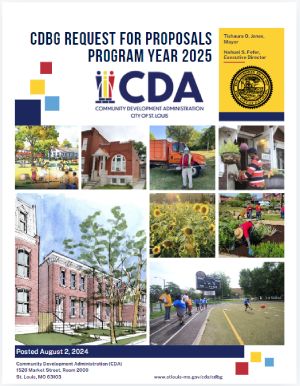
The CDBG program was established by Congress in 1974 through the Housing and Community Development Act. The United States Department of Housing and Urban Development (HUD)’s CDBG program develops urban communities by funding affordable housing, improving quality of life neighborhoods, and expanding economic opportunities primarily for low- and moderate-income individuals. CDBG operates on an annual funding cycle, and each year, municipalities and local governments are allocated funds to support various community development initiatives. CDBG funds are administered locally by the City of St. Louis’ CDA. The prior 2024 program year funding cycle had $4,996,484 of available funds.
Save the date: CDA will host a CDBG Financial Management Best Practices Webinar at 10 am, Thursday, August 15, 2024
CDA is currently developing its 2025 ‐ 2029 Consolidated Plan. The Consolidated Plan process is data-driven and involves enhanced citizen participation. The following 2025 priorities have been identified from utilizing data from the 2025 – 2029 Consolidated Plan community-wide focus groups, a review of existing and active departmental plans, and federal CDBG statutes and regulations. All applications must still meet one of HUD’s three national objectives and be an eligible activity. All CDBG-funded activities must meet one of the following national objectives: benefit low- and moderate-income (LMI) persons/households or prevent or eliminate slum or blight.
City of St. Louis Priorities / Eligible Activities:
High Priorities
- Youth Services
- Relocation
- Drug Abuse Counseling & Treatment
- Health Services & Public Improvements
Other Priorities
- Economic Development
- Affordable Housing: Rental & Homeowner Assistance, Production of New Units, and Rehabilitation of Existing Units
- Planning
- Public Facilities
- Public Improvements & Infrastructure
- Administration
Targeted Areas: The Neighborhood Revitalization Strategy Areas (NRSAs) are targeted areas for prioritized investment. The proposed NRSAs for HUD approval as part of the 2025-2029 Consolidated Plan include:
North NRSA: Baden, North Pointe, and Walnut Park West neighborhoods
- Northwest NRSA: Wells-Goodfellow, Hamilton Heights, Kingsway East, and Kingsway West neighborhoods
- North Central NRSA: Greater Ville, Ville, Jeff Vanderlou, Vandeventer, Lewis Place, and Fountain Park neighborhoods
- Choice NRSA: Near Northside Choice Neighborhood Footprint and Old North St. Louis and St. Louis Place neighborhoods
These areas will receive enhanced flexibility and bonus points for projects that benefit the residents within these designated NRSAs.
Commercial Facade Improvement Program Revamp
The CDA is now administering the Commercial Facade Improvement Program. This program provides 5-year forgivable loans to small business and commercial property owners to incentivize improvement of the character and physical appearance of their building exteriors and storefronts. The application and instructions for the Commercial Facade Improvement Program are in the 2025 CDBG RFP document.
Application Process
The CDA encourages both existing grantees and new applicants, including non-profits, neighborhood groups, and Community-Based Development Organizations (CBDOs), to apply for funding. This annual cycle offers an opportunity for organizations to secure funding for projects that align with the CDBG program’s goals and priorities.
Interested organizations should visit the CDA website at www.stlouis-mo.gov/cda/cdbg to access the full RFP document and detailed instructions on eligibility, required documentation, and the application process. All proposals must be submitted through EGrAMS, CDA’s electronic grants management system available at www.stlouis-mo.gov/cda/egrams/
Important Dates
- 7/22/24: Funding Priorities Published
- 8/2/24: Issued CDBG Non-Housing Production RFP
- 8/2/24: Held Public Hearing and Hybrid RFP Overview: Timeline, Process, Eligible Applicants & Uses
- 8/15/24: Virtual Capacity Building Training Best Practices: Financial Management; Reporting & Recordkeeping
- 9/6/24: CDBG Proposals Due to CDA
- 10/11/24: Funding Recommendations Posted to CDA Website
- 10/11/24: Annual Action Plan Posted for Public Comment
- 10/11/24: Introduction of Board Bill
- 10/11/24: Board Bill Submitted to Mayor’s Office for E&A Approval
- Week of 10/15/24: HUDZ Committee Meeting No. 1
- Week of 10/18/24: Board of Aldermen Second Reading
- Week of 10/25/24: Board of Aldermen Perfected Reading
- Week of 11/1/24: Board of Aldermen Final Reading
- 11/7/24: Public Hearing No. 2 (Funding Awards)
- 11/15/24: Final 2024 Annual Action Plan Submitted to HUD
The public hearing recording is available on the City of St. Louis’ YouTube channel. Organizations can also check the Neighborhood Revitalization Strategy Areas map for targeted areas.
About the Community Development Administration
The Community Development Administration (CDA) is committed to enhancing the quality of life in St. Louis through strategic investments in housing, economic development, and public services. The CDA works to ensure that all residents have access to safe, affordable housing and opportunities for economic advancement.
The Board of E&A will consider a vote to recommend and submit the budget to the Board of Aldermen for adoption.
On April 23, 2025, the proposed FY26 Annual Operating Plan and budget was presented to the Board of Estimate and Apportionment (E&A) made up of the Mayor, the Comptroller, and the President of the Board of Aldermen. The Board of E&A will preside over a public hearing on the budget this Friday, April 25th at 1:00 pm. On Tuesday, April 29th, E&A will consider a vote to recommend and submit the budget to the Board of Aldermen (BOA) for adoption. (Per charter requirements, the Board of E&A must recommend and submit the budget 60 days prior to the start of the fiscal year, or May 1.)
Next Steps
The budget will be introduced at the Board of Aldermen and assigned the designation of Board Bill No. 1. During the months of May and June, the Budget and Public Employees Committee of the Board of Aldermen will hold hearings on the budget to hear from various City departments as well as public hearings to hear from the general public.
The Budget and Public Employees Committee typically considers a number of amendments to the budget, including additions and reductions. As amendments recommending increases require approval by the Board of E&A, the committee will submit any requested increases to the Board of E&A for consideration. The Board of E&A will consider amendments and submit its response back to the Budget Committee which will take action on the budget and submit the budget to the full Board of Aldermen for its consideration.
Per the charter, the Board of Aldermen must take final action on the budget by June 30, prior to the start of the new fiscal year.